How does a spell checker work? A clear guide

A spell checker works by scanning your text word by word, comparing each token against a reference dictionary, and flagging anything that does not match. When a mismatch is found, algorithms calculate the most likely intended word and surface it as a correction suggestion. That core process has stayed consistent for decades. What has changed dramatically is the intelligence layered on top of it.
Table of Contents
- How spell checkers identify and correct misspellings
- How AI and NLP take spell checker technology further
- Limitations to know and best practices for website content
- Websitespellchecker: AI-powered auditing for your entire site
- How dictionaries and lexicons are built and managed
- Key takeaways
How spell checkers identify and correct misspellings
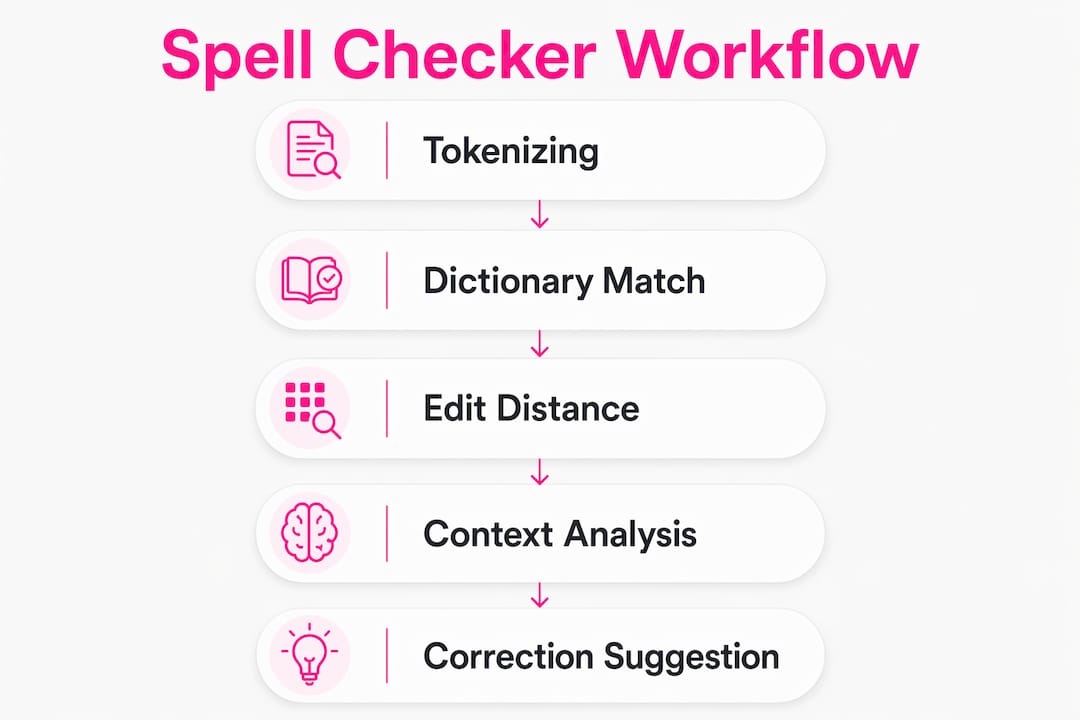
The spell check process follows a clear sequence, and understanding it helps you configure your tools more effectively:
- Text parsing: The software breaks your content into individual tokens, separating words from punctuation, formatting, and whitespace.
- Dictionary comparison: Each token is matched against a database of correctly spelled words. Any word absent from that database is flagged for review.
- Edit distance calculation: Levenshtein distance measures how many single-character insertions, deletions, or substitutions separate a misspelling from a valid word. Fewer edits means a higher-ranked suggestion.
- Morphological analysis: A morphological engine recognises plurals, verb conjugations, and possessives as valid forms, preventing unnecessary flags on correctly inflected words.
- Suggestion generation: Candidate corrections are ranked by edit distance and word frequency, with the most probable match presented first.
This pipeline is fast and reliable for clear-cut typos. Its limitations only become apparent when context matters.
How AI and NLP take spell checker technology further
Basic dictionary matching catches obvious errors. Modern spell checker technology goes further by understanding the sentence around each word.
- Natural language processing (NLP): Rather than evaluating words in isolation, NLP-powered tools analyse entire sentences to determine whether a correctly spelled word is actually appropriate in context. This is how “their” and “there” can finally be distinguished automatically.
- Statistical n-gram models: N-gram analysis assesses the frequency of letter or word sequences across large language corpora. Unusual sequences signal a likely error, even for words not in any dictionary.
- Noisy channel model: This probabilistic approach treats a misspelling as a distorted version of the intended word. The noisy channel model combines edit distance probabilities with word frequency data to estimate what the writer most likely meant.
- Machine learning: Spell checkers that incorporate machine learning adapt over time by studying user correction patterns, making future suggestions progressively more relevant.
- Multi-technique integration: The most accurate tools combine dictionary lookup, statistical analysis, and machine learning rather than relying on any single method.
For website content teams, this matters. A tool that only catches “teh” will miss “pubic” when you meant “public,” or “manger” when you meant “manager.” Sentence-level analysis closes that gap.
Limitations to know and best practices for website content
Spell checkers are excellent first-pass tools. They are not a complete quality control strategy on their own.
- Homophones and real-word errors: A word spelled correctly but used wrongly (“compliment” vs “complement”) will pass a basic dictionary check without issue.
- False positives from technical vocabulary: Brand names, product codes, and industry terms trigger unnecessary flags unless your dictionary is configured to include them.
- Alert fatigue: Over-flagging valid words, particularly morphological variants, causes teams to dismiss warnings habitually, which is when genuine errors slip through.
- Overreliance risk: Spell checkers are probabilistic systems, not authoritative judges. Treating their output as final without human review leads to complacency.
- Human proofreading remains necessary: Experts consistently note that automated tools cannot fully replace a trained human eye, particularly for specialised terminology, brand consistency, and tone.
Understanding the difference between free and paid tools is also worth your time. Free checkers typically lack custom dictionary support and site-wide scanning, which creates real gaps for professional content management.
Pro Tip: Configure a custom dictionary for every project. Add your brand names, product terms, and industry vocabulary before running any audit. This single step dramatically reduces false positives and keeps your team focused on genuine errors.
Websitespellchecker: AI-powered auditing for your entire site
Knowing how spell checkers function is useful. Having a tool built specifically for professional, site-wide auditing is what actually protects your reputation.
Websitespellchecker uses AI scanning technology to check every page of your website in one pass, not just the document you have open right now. Here is what that means in practice:
- Site-wide coverage: Every page is scanned automatically, so errors buried in older blog posts or product descriptions do not go unnoticed.
- Instant, detailed reports: Results arrive immediately, with errors categorised and prioritised so your team knows exactly where to focus. You can view your full spell check report and share it as a downloadable PDF.
- Scan history tracking: Websitespellchecker records previous scans, letting you monitor content quality over time and demonstrate improvement to clients or stakeholders.
- Multi-language support: If your site serves audiences in more than one language, the tool applies appropriate dictionaries for each, reducing cross-language false positives.
- Bespoke dictionary management: Add your own terminology, brand names, and technical vocabulary so the tool works for your specific content, not a generic standard.
- Built for agencies and developers: Agency and developer teams can manage multiple client sites from one platform, with configurable scans and shareable outputs.
No monthly subscription is required. You pay per page scanned, with a free tier to get started.
How dictionaries and lexicons are built and managed
The quality of any spell checker depends entirely on the quality of its underlying dictionary. A dictionary in this context is not simply a word list. It is a structured lexicon that may include grammatical attributes, hyphenation points, morphological rules, and frequency data.

Dictionaries are built from large text corpora, such as the British National Corpus, supplemented by curated word lists and domain-specific sources. Morphological rules are encoded separately, allowing the engine to accept “running,” “ran,” and “runs” without storing every inflected form individually. This keeps storage requirements manageable while maintaining broad coverage.
For professional website management, lexicon quality has a direct impact on audit reliability. A general-purpose dictionary will flag legitimate technical terms, product names, and proper nouns as errors. Custom lexicons solve this by extending the base dictionary with your organisation’s specific vocabulary. Tools like Websitespellchecker support bespoke dictionary configuration precisely because a one-size-fits-all word list is not sufficient for business content at scale. Maintaining that custom lexicon, updating it as your product range or terminology evolves, is an ongoing task rather than a one-time setup.
Key takeaways
Modern spell checkers combine dictionary matching, edit distance algorithms, and AI-driven NLP to catch errors that isolated word checks would miss entirely.
| Point | Details |
|---|---|
| Core mechanism | Spell checkers parse text into tokens, compare each against a dictionary, and use Levenshtein distance to rank correction suggestions. |
| AI and NLP advances | Sentence-level analysis via NLP catches contextual errors such as homophones that basic dictionary matching cannot detect. |
| Limitations matter | Spell checkers are probabilistic tools; human proofreading remains necessary for specialised vocabulary and brand consistency. |
| Dictionary quality is critical | Custom lexicons tailored to your organisation’s terminology reduce false positives and improve audit reliability at scale. |
| Websitespellchecker for professionals | AI-powered site-wide scanning, scan history tracking, and bespoke dictionary support make it suited for business and agency content auditing. |