British vs American spelling: the rules that actually matter

Pick one variety, British or American, and stay with it from your homepage to your footer. That single decision, backed by a named style guide such as Oxford or Merriam-Webster, solves more spelling headaches than memorising a thousand word pairs ever will. Most differences between British vs American spelling fall into a handful of predictable pattern families, and once you know them, you can spot the correct version for your audience rather than guessing.
Here’s what you’re dealing with: -our/-or, -re/-er, -ise/-ize, -yse/-yze, -ae/-e and -oe/-e, -ogue/-og, doubled consonants before suffixes, and -ce/-se.
- Learn the pattern, not the pair — it covers dozens of words at once.
- Confirm edge cases against a dictionary rather than guessing from memory.
- Apply the same variety to headings, body text, alt text, and metadata.
Most of these forms trace back to a specific moment in publishing history. Noah Webster’s early 19th-century reforms deliberately simplified American spelling, stripping the “u” from colour and swapping “re” for “er” in words like theatre, largely to give the young United States its own linguistic identity. British English simply kept the older French and Latin-influenced forms that predate that reform.
Key Takeaways
Consistency, not memorisation, is what separates confident British vs American spelling from constant second-guessing across a website or manuscript.
| Point | Details |
|---|---|
| Pick one variety | Commit to British or American spelling for an entire document or site, not page by page. |
| Learn patterns, not pairs | Master the eight core pattern families to cover most spelling differences automatically. |
| Watch the exceptions | Words like aluminium, cheque, and programme break the normal rules and need memorising individually. |
| Follow a named dictionary | Use Oxford or Merriam-Webster as your reference, and note Oxford’s acceptance of -ize. |
| Automate the enforcement | Site-wide scanning catches mixed spellings across pages that manual reviews tend to miss. |
Table of Contents
- British vs American spelling patterns you’ll meet constantly
- Exceptions and confusing cases worth flagging
- How to choose a variety and enforce it consistently
- British vs American spelling: a quick reference table
- Keeping a website consistent once it grows past one page
- Why the pattern approach beats memorising word lists
- Sources
British vs American spelling patterns you’ll meet constantly
Once you can name the pattern, you stop second-guessing individual words. Each family below follows a consistent rule, with a handful of genuine exceptions worth flagging as you go.
-our vs -or
British English keeps the French-derived “our” ending in words like colour, favour, honour, labour, and neighbour. American English drops the “u”: color, favor, honor, labor, neighbor. This is one of the oldest and most visible splits, and it applies consistently across the entire word family, so colourful often becomes colorful and favourite becomes favorite.
-re vs -er
British spelling puts “re” at the end of centre, theatre, litre, and metre. American spelling swaps the order to center, theater, liter, and meter. An exception is “meter” as in a measuring device, which is spelled the same in both varieties; generally this pattern applies to units of length and theatre/theater.
-ise vs -ize
This is the pair most writers get wrong, because the rule isn’t as clean as the others. American English typically uses -ize: organize, realize, recognize. British English often favours -ise: organise, realise, recognise. However, some British sources, like Oxford spelling, accept -ize for many verbs due to etymology. That’s why you’ll see “organization” in plenty of British academic writing without it being a mistake.
The complication runs deeper. Some verbs are etymologically fixed and can never take -ize, regardless of which variety you’re writing in. “Advertise”, “surprise”, and “compromise” always end in -ise because the “s” is part of the word’s Latin root, not a suffix choice. Mixing these up isn’t a British-versus-American issue; it’s simply incorrect in both.
-yse vs -yze
British English writes analyse, paralyse, and catalyse. American English writes analyze, paralyze, and catalyze. Unlike -ise/-ize, this pattern has no permissive exception on the British side. In British English, -yse is the accepted form for relevant verbs.
-ae/-oe vs -e
Older British spellings often retain Latin and Greek digraphs such as anaemia and oesophagus, while American English generally simplifies these to anemia and esophagus. This pattern shows up most in medical and scientific writing, where getting it wrong in a journal submission can flag a manuscript for correction before it even reaches peer review.
-ogue vs -og
British English often uses catalogue, dialogue, and analogue, whereas American English commonly uses catalog, dialog, and analog, though dialogue remains common in both. Analog has actually become the dominant spelling in both varieties when referring to non-digital electronics.
Doubled consonants before suffixes
British English tends to double a final “l” before adding suffixes like -ing, -ed, or -er in many cases; American English usually uses a single “l”. This rule reverses for some words, which is exactly why it trips up even confident writers.
-ce vs -se
British English distinguishes nouns and verbs with -ce and -se endings, respectively, while American English generally uses -se for both nouns and verbs.
-wards vs -ward
British English tends to use -wards in directional words, while American English often drops the ‘s’ ending. Both forms are understood, but consistency is important.
| Pattern | British form | American form |
|---|---|---|
| -our/-or | colour, favour | color, favor |
| -re/-er | centre, theatre | center, theater |
| -ise/-ize | organise, realise | organize, realize |
| -yse/-yze | analyse, paralyse | analyze, paralyze |
| -ae/-e | anaemia, oesophagus | anemia, esophagus |
| -ogue/-og | catalogue, dialogue | catalog, dialog |
| doubled consonant | travelling, labelled | traveling, labeled |
| -ce/-se | licence (noun), defence | license (noun/verb), defense |
Spelling differences are actually the most visible part of the British versus American split, but they’re outnumbered by vocabulary and pronunciation differences overall, and American spelling conventions are steadily creeping into British usage through digital media and global publishing, according to Cambridge University Press.
Exceptions and confusing cases worth flagging
Every pattern has outliers, and a handful of specific words cause more confusion than the systematic rules combined.
- Aluminium vs aluminum: this isn’t a simple spelling variant. British English uses “aluminium” (four syllables, matching other elements like sodium and potassium), while American English uses “aluminum” (three syllables). The word itself was respelled, not just re-suffixed.
- Cheque vs check: British English keeps “cheque” for the banking instrument but uses “check” for verification, inspection, or a pattern of squares. American English uses “check” for all three meanings, which occasionally causes ambiguity in financial writing.
- Programme vs program: British English traditionally uses “programme” for a TV schedule, theatre listing, or event agenda, but switches to “program” when referring to computer software. American English uses “program” for everything. Get this one wrong in a software context and you’ll look dated rather than simply British.
- Whilst vs while: both are grammatically correct in British English, but “whilst” reads as noticeably formal or old-fashioned. American English doesn’t use “whilst” at all.
- Grey vs gray: British English uses “grey” almost universally; American English defaults to “gray”, though both spellings appear in dictionaries on either side of the Atlantic.
- Jewellery vs jewelry: British English doubles the “l” and keeps the extra “e”; American English simplifies to jewelry.
Past-tense verb forms split in a similar, easily missed way. British English often uses -t endings for certain irregular verbs (learnt, spilt), whereas American English typically uses -ed endings (learned, spilled). Both forms are generally acceptable in British English, but consistent usage is recommended.
The “get” family causes its own confusion. British English uses “got” as the past participle, while American English uses “gotten” in many contexts; the “gotten” form has declined in British usage but remains common in America.
If you’re writing for an international or mixed audience and can’t confidently commit to one variety throughout, default to the more broadly recognised form in context: “check” over “cheque” outside banking, “program” for anything software-related regardless of variety, and -ize spellings if you expect a largely American readership. When genuinely unsure, Editage’s guidance for academic authors is that journals frequently specify a required variety, and manuscripts that mix the two are often returned for correction before review even begins.
How to choose a variety and enforce it consistently
Deciding between British and American spelling isn’t really a language question. It’s an audience and publishing question, and the answer usually falls out once you ask three things in order.
- Identify your primary audience. If most of your readers, customers, or students are in the UK, Ireland, Australia, or much of the Commonwealth, British spelling is the safer default. If your audience is predominantly American, or you’re publishing through a US-based platform or journal, American spelling wins.
- Check for an imposed house style. Academic journals, publishers, and many corporate style guides specify a variety outright. If you’re submitting to a journal, that instruction overrides your own preference; ignoring it is one of the most common reasons manuscripts get sent back for revision.
- Match your style guide to your choice. For British English, lean on the Oxford English Dictionary, Collins, or Cambridge Dictionary. For American English, use Merriam-Webster or the Chicago Manual of Style. Academic authors should always defer to journal-specific instructions over any general guide.
- Document your exceptions. Every house style accumulates a few settled calls, like “program” for software in an otherwise British document. Write these down once so nobody has to relitigate them later.
- Run automated checks before publishing. A tool that scans your entire site or document against your chosen dictionary catches mixed spellings far faster than a manual read-through, especially across dozens of pages.
- Sample-check high-traffic or high-stakes pages by hand. Automation catches most errors, but your homepage, pricing page, and top blog posts deserve a human pass too.
Pro Tip: Keep a simple shared document listing your chosen variety and every agreed exception (like “program” for software in British copy). It takes ten minutes to set up and saves hours of back-and-forth with every new writer or editor who joins the project.
If you manage a team of writers rather than working solo, proofreading tools built for editorial workflows make this decision far easier to enforce, because the rule only works if everyone applies it the same way.
British vs American spelling: a quick reference table
Bookmark this table or screenshot it. It covers the pairs you’ll actually encounter in everyday and academic writing, not obscure edge cases.
| British spelling | American spelling | Note |
|---|---|---|
| colour, favour, honour | color, favor, honor | Full word family follows the pattern |
| centre, theatre, litre | center, theater, liter | “Meter” (device) is spelled the same in both |
| organise, realise | organize, realize | Oxford accepts -ize in many cases |
| analyse, paralyse | analyze, paralyze | No permissive exception in British English |
| catalogue, dialogue | catalog, dialog | “Dialogue” for conversation stays common in both |
| travelling, labelled | traveling, labeled | Doubled consonant before the suffix |
| licence (noun), defence | license (noun/verb), defense | American English drops the noun/verb distinction |
| programme (TV, event) | program | Both use “program” for software |
| aluminium | aluminum | Different word, not just a suffix swap |
| grey | gray | Both spellings appear in most dictionaries |
Context-dependent pairs like programme/program deserve extra care, since the “correct” choice depends on subject matter as much as regional variety. When a single word has more than one accepted British form, such as learnt/learned, pick one and use it throughout the same document rather than alternating.
Keeping a website consistent once it grows past one page
Choosing a variety is the easy part. Enforcing it across every page, product description, and blog post a site accumulates over several years is where most businesses actually lose the thread, and mixed spellings quietly chip away at how professional a site looks to visitors and search engines alike.
A site-wide scanning workflow solves this more reliably than relying on individual writers to remember the house rule:
- Set your chosen variety and dictionary once, so every scan checks against the same standard.
- Run a full site scan to surface every instance of mixed spelling, not just the pages you remember to check.
- Export a shareable report so editors and writers can see exactly what needs fixing, page by page.
- Track changes over time to confirm new content stays consistent as your site grows.
Automated, site-wide spelling checks catch the mixed-variety errors that manual reviews routinely miss, particularly on older pages nobody has opened in months. This matters more than it sounds: a site that says “colour” on its homepage and “color” three clicks later reads as careless, even when every individual sentence is grammatically fine.
Pro Tip: Run your first full scan before you set a house style, not after. Seeing exactly how inconsistent your existing content already is makes the case for a documented standard far more convincing than any style guide on its own.
Why the pattern approach beats memorising word lists
Most advice on this topic still treats British versus American spelling as a memorisation exercise: study a list, quiz yourself, hope it sticks. That’s backwards. The eight pattern families above explain the overwhelming majority of differences, and once they’re internalised, you can predict the correct form for a word you’ve never seen written out before.
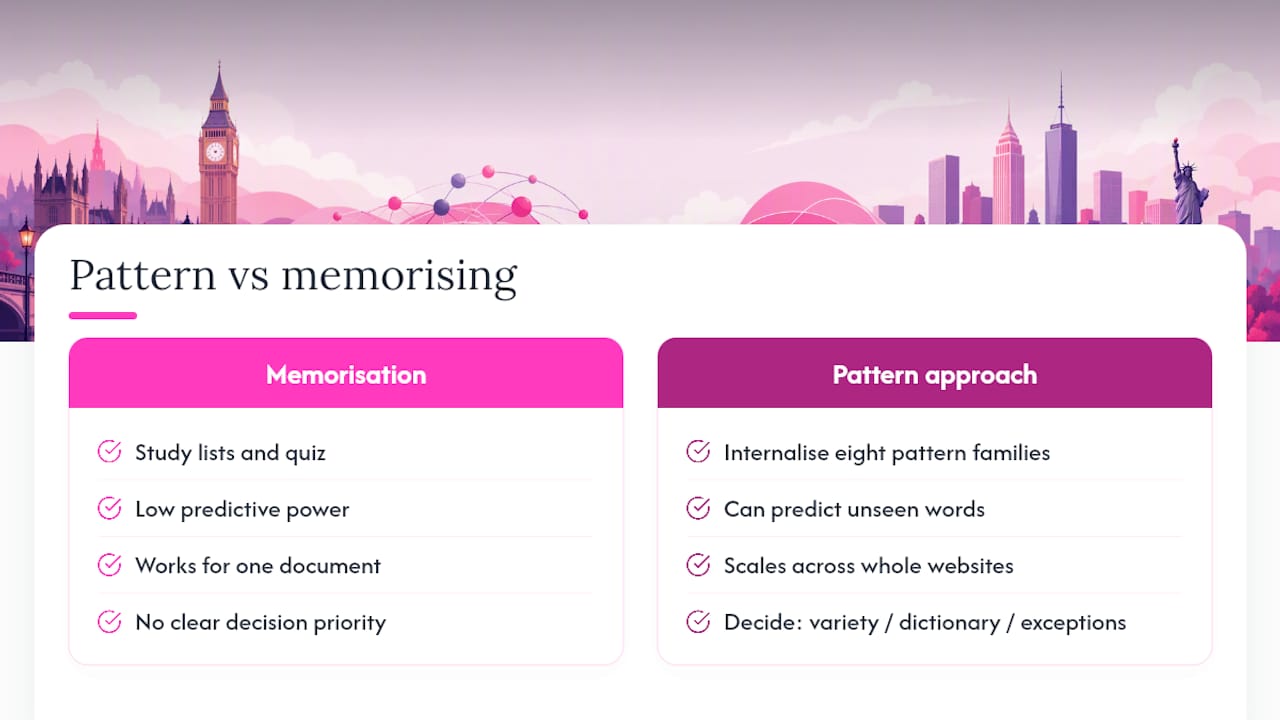
Where conventional advice really falls short is scale. Getting one document consistent is trivial. Getting a website with hundreds of pages, built up by different writers over several years, consistent is a different problem entirely, and it’s the one most style guides ignore. Nobody remembers that a blog post from three years ago used “color” once by accident.
Prioritise the decision first: variety, dictionary, documented exceptions. Then prioritise verification, because a rule nobody checks is just a suggestion. That’s the gap automated scanning actually closes.
— Website
Sources
Consult these directly whenever a specific word or pattern falls outside what’s covered above.